


The most important line in Tesla’s Q1 2026 shareholder letter has almost nothing to do with cars.
“2025 marked a critical year for Tesla as we further expanded our mission and continued our transition from a hardware-centric business to a physical AI company.”
A company that builds cars, batteries, factories, robots, and inverters is telling its shareholders, on the record, that it no longer considers itself hardware-centric. It considers itself a physical AI company.
That is not a tagline. It is positioning. And positioning is a forcing function — once you commit to it externally, you allocate capital around it internally.
Tesla is. And the implications run far beyond Tesla.
The capital allocation matches the narrative
- Energy storage revenue: $2.4B in Q1, down 12% YoY. Not because demand is weak — Megapack is supply-constrained. Tesla cannot pour concrete fast enough.
- AI infrastructure on the balance sheet: $7.7B, up from $6.8B at year-end. Nearly $1B added in a single quarter.
- A $2B agreement to acquire an AI hardware company, announced in April.
- 2026 capex guided to more than double 2025’s ~$8.5B, with significant allocation to AI compute, semiconductors, and software-enabled products.
Full Self-Driving rebuilt on a new architecture, with monetization explicitly framed through “services powered by our AI software.”
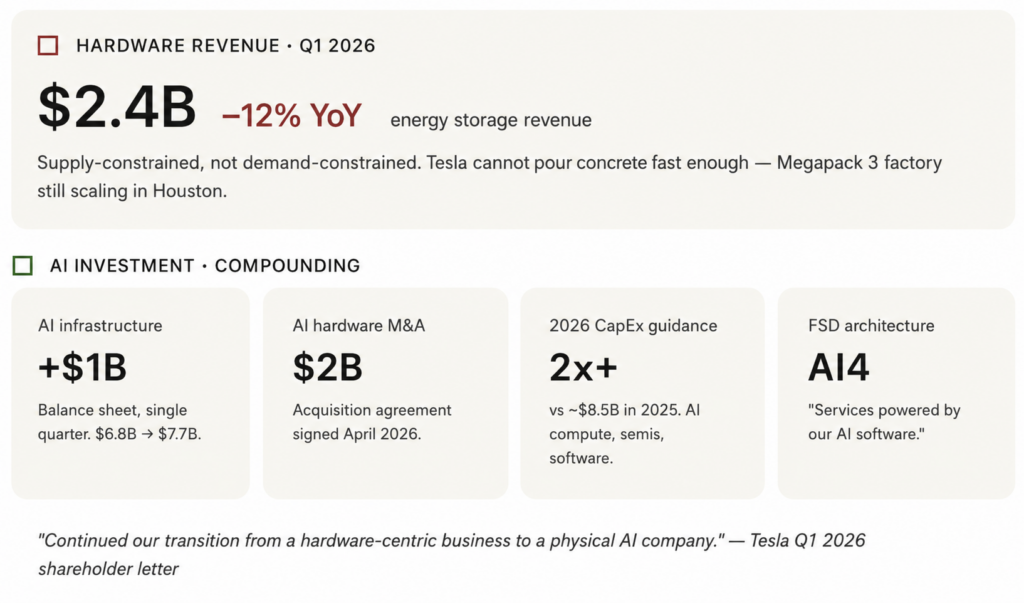
Hardware revenue under pressure. AI investment compounding. Forward narrative pivoted to software-enabled services.
This is what a category transition looks like when it happens in real time, at the most vertically integrated battery and energy company in the world.
The constraint has moved
For a decade, the energy transition has been told as a hardware race. Cells, packs, gigawatt-hours, dollars per kWh. The assumption: whoever ships the cheapest electron-storage device wins.
Tesla’s own Q1 results suggest a different hypothesis. Storage demand is now effectively unbounded — driven by data centers, grid load growth, electrification, and AI compute itself. No hardware company on earth can manufacture fast enough to meet it. In that world, the marginal return on shipping one more kWh starts to fall below the marginal return on making every kWh already in the field meaningfully smarter.
The constraint, in other words, has moved. It is no longer “how do we build more batteries.” It is “how do we extract the full economic value from the batteries we already have.”
That is not a hardware problem. It is an intelligence problem. And it is the problem Electra was built to solve.
The cost of the missing layer
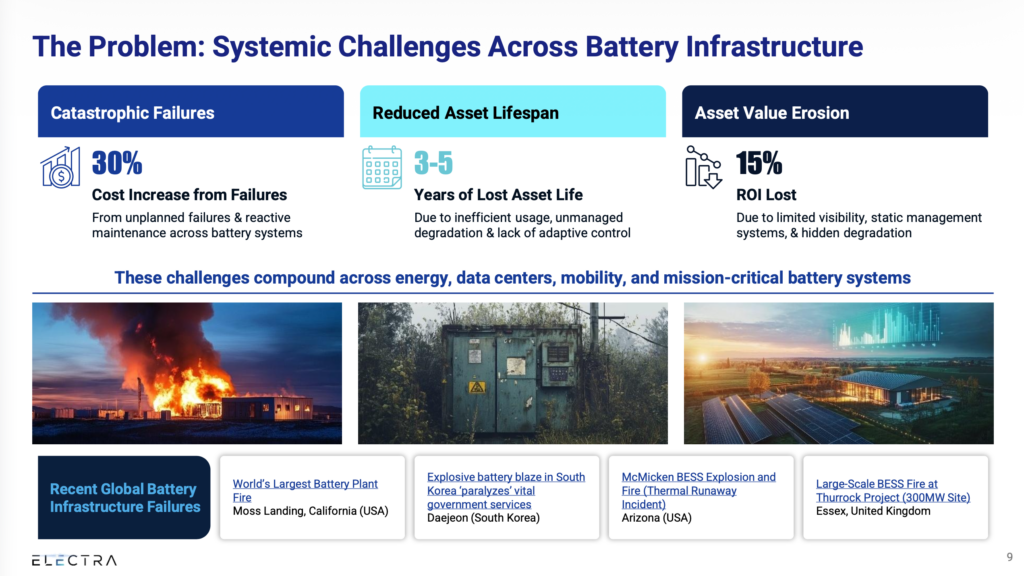
This is not a theoretical problem. The systemic cost of operating batteries without an intelligence layer is measurable across the industry today — and it is enormous.
- 30% cost increase from catastrophic failures, driven by unplanned failures and reactive maintenance across battery systems. The risk is not abstract. Recent global incidents have made the stakes brutally clear: the Moss Landing battery plant fire in California (the world’s largest), the McMicken BESS thermal runaway in Arizona, the Thurrock 300MW BESS fire in the UK, and the Daejeon battery blaze in South Korea that paralyzed vital government services.
- 3 to 5 years of lost asset life, caused by inefficient usage, unmanaged degradation, and lack of adaptive control. Every battery system in the field today is leaving years of useful life — and revenue — on the table.
- 15% of ROI lost to limited visibility, static management systems, and hidden degradation. Value that compounds away from operators, OEMs, and asset owners with every single cycle.
These challenges compound across energy storage, data centers, mobility, and mission-critical battery systems. None of them is a hardware problem. Every one of them is closable in software.
What Electra builds: the AI Brain for Batteries™
Electra is the AI Brain for Batteries™ platform — an independent, hardware-agnostic, chemistry-agnostic software layer that sits on top of any battery and turns it from a passive, degrading asset into a predictable, optimizable, financially modelable one.
Our AI Brain for Batteries™ platform delivers this intelligence across the full asset lifecycle through three integrated capabilities: Monitoring, Optimization, and Controls.
Monitoring — knowing what every cell is actually doing
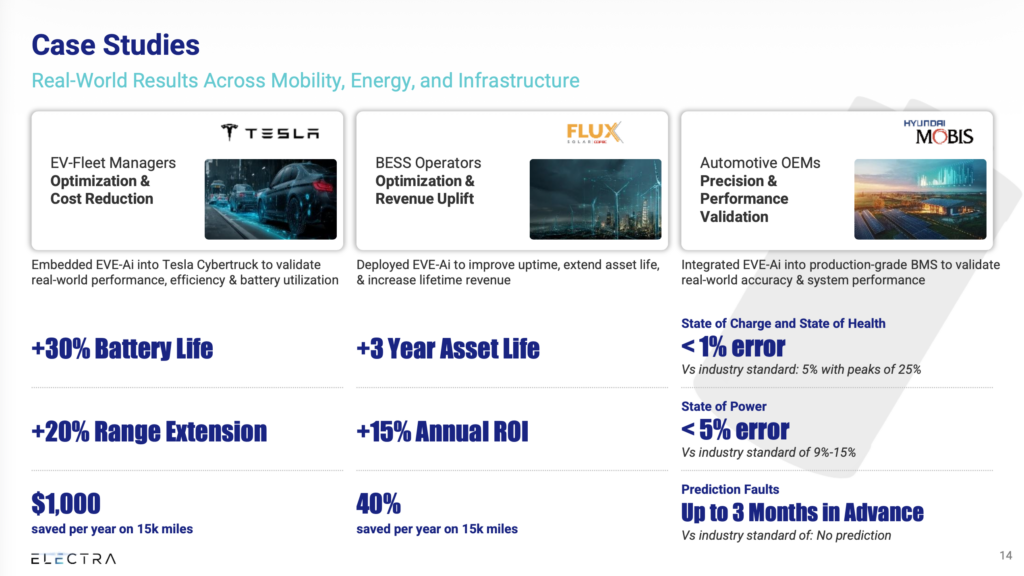
- Advanced modelling and predictive degradation. Asset-specific State of Health, State of Charge, and Remaining Useful Life modeling — replacing fleet-average assumptions with cell-level certainty. In production-grade BMS validation with Hyundai MOBIS, EVE-Ai delivers <1% SoC and SoH error (industry standard: 5%, with peaks of 25%) and <5% State of Power error (industry standard: 9–15%).
- Performance benchmarking. Real-time performance monitoring and intelligent alerts that go beyond standard BMS, giving operators deeper visibility into how every asset is actually performing in the field.
Optimization — extracting the full economic value
- Maximize revenue, minimize cost per cycle. AI-driven optimization of dispatch, thermal, and operating strategy, tuned to each asset’s real physics and duty cycle. In real-world EV fleet validation on Tesla Cybertruck deployments, EVE-Ai delivers +30% battery life, +20% range extension, and $1,000 in savings per vehicle per year at 15,000 miles.
- Informed decisions and smarter planning. Data-driven insights for predictive maintenance, smarter CapEx planning, and lifecycle economics — turning uncertainty into investable numbers.
Controls — closing the loop between intelligence and action
- Proactive safety, minimized risk. Early fault, failure, and explosion-probability detection through advanced models and passive and active controls — predicting faults up to 3 months in advance, versus an industry standard of no prediction at all. With Solar Grid BESS deployments, the same intelligence has delivered +3 years of asset life, +15% annual ROI, and +40% uptime.
Monitoring tells you what is happening. Optimization tells you what should happen. Controls make sure it does.
This is the layer Tesla is building in-house for itself. It is the layer Electra is building, independently, for everyone else.
The Technology Advantage
What makes EVE-Ai™ defensible is not any single model. It is the architecture:
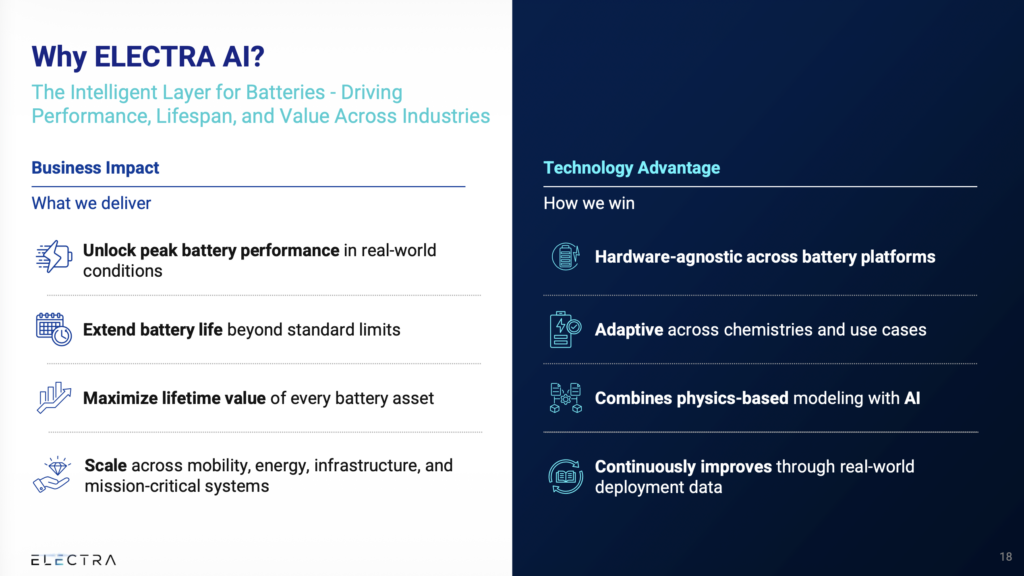
- Hardware-agnostic across battery platforms. Any OEM, any pack, any deployment.
- Adaptive across chemistries and use cases. Lithium-ion, LFP, sodium-ion, hybrid systems — mobility, stationary storage, infrastructure, mission-critical.
- Physics-based modeling combined with AI. Not a black box. Not pure data fitting. A hybrid architecture that respects the underlying chemistry and electrochemistry while leveraging machine learning where it adds value.
- Continuously improves through real-world deployment data. Every cycle, every deployment, every chemistry makes the platform smarter.
This is the kind of layer that takes years to build, requires deep battery-physics expertise alongside AI talent, and cannot be replicated by a hardware company adding a software team. It is a category, not a feature.
Why the rest of the industry needs an independent layer
Tesla is building its intelligence layer in-house. Because Tesla builds everything in-house. That is a structural advantage almost no other company in this industry can replicate.
Every other player — every OEM, utility, storage developer, and fleet operator — needs exactly the same capability. They cannot acquire it from Tesla; Tesla is a competitor, not a vendor. They cannot build it alone at the pace the market is moving; the AI investment Tesla makes in a single quarter is larger than most companies’ entire R&D budget. And they cannot afford to wait, because every deployment going into the ground today without an intelligence layer locks in suboptimal economics for the next 15 to 20 years.
What they need is an open, independent partner whose entire reason for existing is to make their batteries smarter — not to compete with them.
That is the category Electra is building. The AI Brain for Batteries™ is not a feature, and it is not a product line. It is the missing software layer in the energy transition — the one Tesla’s Q1 2026 earnings just confirmed is where the next chapter of this industry will be written.
The next decade
The most interesting industry transitions are rarely marked by a single product launch. They are marked by quiet shifts in language, followed by capital, followed eventually by headlines that arrive years after the rules have already changed.
Tesla’s Q1 2026 is one of those moments for energy. The language has shifted. The capital is following. The headlines will catch up.
The era of dumb batteries is ending. The age of intelligent energy is beginning.
The only real question, for everyone else in this industry, is whether to build the intelligence layer alone — or partner with the company that has already built it.
About ELECTRA AI (Nasdaq: IRHO)
ELECTRA AI is the leading AI-driven cleantech and B2B software company, accelerating the world’s transition to electrification by unlocking the full potential of battery technology. ELECTRA AI builds the AI Brain for Batteries™ — a unified intelligence layer that enables battery systems to be monitored, optimized, and controlled across their full lifecycle. By combining Agentic AI, Physical AI, Physics-informed Battery Modeling with Large Quantitative Models (LQMs), ELECTRA AI transforms batteries from passive hardware into intelligent, adaptive, and increasingly autonomous assets.
ELECTRA AI powers battery intelligence across every major battery-powered sector, including Energy Infrastructure (BESS for grid, renewables, and data centers), autonomous systems (robotics, humanoid, space assets), and e-mobility, helping make electrification safer, more resilient, and more economically productive. ELECTRA AI was co-founded in 2015 by Fabrizio Martini, inspired by work conducted as a Principal Investigator on NASA projects.
About Iron Horse Acquisition II Corp.
Iron Horse Acquisition II Corp. (Nasdaq: IRHO) (www.ironhorseacquisition.com) is a special purpose acquisition company co-founded by CEO and Chairman Jose Antonio Bengochea and CFO Bill Caragol. Iron Horse completed its initial public offering in December 2025, raising gross proceeds of approximately $230 million. Iron Horse was formed for the purpose of effecting a merger, capital stock exchange, asset acquisition, stock purchase, reorganization, or similar business combination with one or more businesses, with a particular focus on companies in the AI, media, and technology sectors.
MEDIA CONTACTS
Giovanni Rossi
Head of Marketing and Communications @ ELECTRA AI
grossi@electrabrain.ai
Investor Relations for ELECTRA AI: ELECTRA@mzgroup.us
Forward-Looking Statements
Certain statements in this press release may be considered “forward-looking statements” within the meaning of the “safe harbor” provisions of the U.S. Private Securities Litigation Reform Act of 1995. Forward-looking statements generally relate to future events or Iron Horse’s or Electra’s future financial or operating performance. For example, statements regarding the anticipated timing of closing, expectations regarding the combined company’s business, and potential benefits of the transaction are forward-looking statements. In some cases, you can identify forward-looking statements by terminology such as “may,” “should,” “expect,” “intend,” “will,” “estimate,” “anticipate,” “believe,” “predict,” “potential,” or “continue,” or the negatives of these terms or variations of them or similar terminology. Such forward-looking statements are subject to risks, uncertainties, and other factors which could cause actual results to differ materially from those expressed or implied by such forward-looking statements. These forward-looking statements are based upon estimates and assumptions that, while considered reasonable by Iron Horse and Electra and their respective management teams, are inherently uncertain. Factors that may cause actual results to differ materially from current expectations include, but are not limited to: (i) the occurrence of any event, change, or other circumstances that could give rise to the termination of the BCA; (ii) the outcome of any legal proceedings that may be instituted against Iron Horse, Electra, the combined company, or others following the announcement of the transaction; (iii) the inability to complete the transaction due to the failure to obtain approval of the stockholders of Iron Horse or to satisfy other conditions to closing; (iv) changes to the proposed structure of the transaction that may be required or appropriate as a result of applicable laws or regulations or as a condition to obtaining regulatory approval of the transaction; (v) the ability to meet Nasdaq’s continued listing standards following the consummation of the transaction; (vi) the risk that the transaction disrupts current plans and operations of Electra as a result of the announcement and consummation of the transaction; (vii) the ability to recognize the anticipated benefits of the transaction, which may be affected by, among other things, competition, the ability of the combined company to grow and manage growth profitably, maintain relationships with customers and suppliers and retain its management and key employees; (viii) costs related to the transaction; (ix) changes in applicable laws or regulations; and (x) the possibility that Electra or the combined company may be adversely affected by other economic, business, and/or competitive factors. Nothing in this press release should be regarded as a representation by any person that the forward-looking statements set forth herein will be achieved or that any of the contemplated results of such forward-looking statements will be achieved. You should not place undue reliance on forward-looking statements, which speak only as of the date they are made. Neither Iron Horse nor Electra undertakes any duty to update these forward-looking statements, except as required by law.
No Offer or Solicitation
This press release does not constitute a solicitation of a proxy, consent, or authorization with respect to any securities or in respect of the proposed transaction, and shall not constitute an offer to sell or a solicitation of an offer to buy any securities, nor shall there be any sale of securities in any state or jurisdiction in which such offer, solicitation, or sale would be unlawful prior to registration or qualification under the securities laws of any such state or jurisdiction. No offering of securities will be made except by means of a prospectus meeting the requirements of Section 10 of the Securities Act of 1933, as amended, or an exemption therefrom.
Additional Information about the Business Combination and Where to Find It
In connection with the proposed business combination, Iron Horse and Electra intend to file a registration statement on Form S-4 (the “Registration Statement”) with the SEC, which will include a proxy statement/prospectus, and certain other related documents, to be used at the meeting of stockholders to approve the proposed business combination. INVESTORS AND SECURITY HOLDERS OF IRON HORSE ARE URGED TO READ THE PROXY STATEMENT/PROSPECTUS, ANY AMENDMENTS THERETO, AND OTHER RELEVANT DOCUMENTS THAT WILL BE FILED WITH THE SEC CAREFULLY AND IN THEIR ENTIRETY WHEN THEY BECOME AVAILABLE BECAUSE THEY WILL CONTAIN IMPORTANT INFORMATION ABOUT ELECTRA, IRON HORSE, AND THE BUSINESS COMBINATION. The definitive proxy statement will be mailed to shareholders of Iron Horse as of a record date to be established for voting on the proposed business combination and other proposals. Investors and security holders will also be able to obtain copies of the Registration Statement and other documents containing important information about each of the companies once such documents are filed with the SEC, without charge, at the SEC’s website at www.sec.gov, or by directing a request to: Loeb & Loeb LLP.