


Every major technology shift has a moment where the curve bends — where something that was niche, expensive, or experimental quietly becomes infrastructure. Electrification is at that moment now. And the part of the story that gets the least attention is the part that will matter most.
The hardware story is well understood. Battery chemistries are improving. Manufacturing scale is growing. Costs keep falling. What’s changing underneath all of it — and what almost no one is pricing in — is that batteries are becoming the connective tissue of the entire energy economy, deployed across markets that barely overlapped a decade ago.
The question is no longer whether the world electrifies. It’s whether the software managing all that stored energy can keep up. And here is the uncomfortable truth: the battery has quietly become the most critical infrastructure of the energy transition — and the one layer of it we still, mostly, fly blind on. Closing that gap isn’t a feature upgrade. It’s the birth of a category: battery intelligence.
Source Note: Unless otherwise stated, all market data, forecasts, and insights presented from this point forward are derived from the MarketsandMarkets™ Battery Management System Market – Global Forecast (2026).
The BESS boom
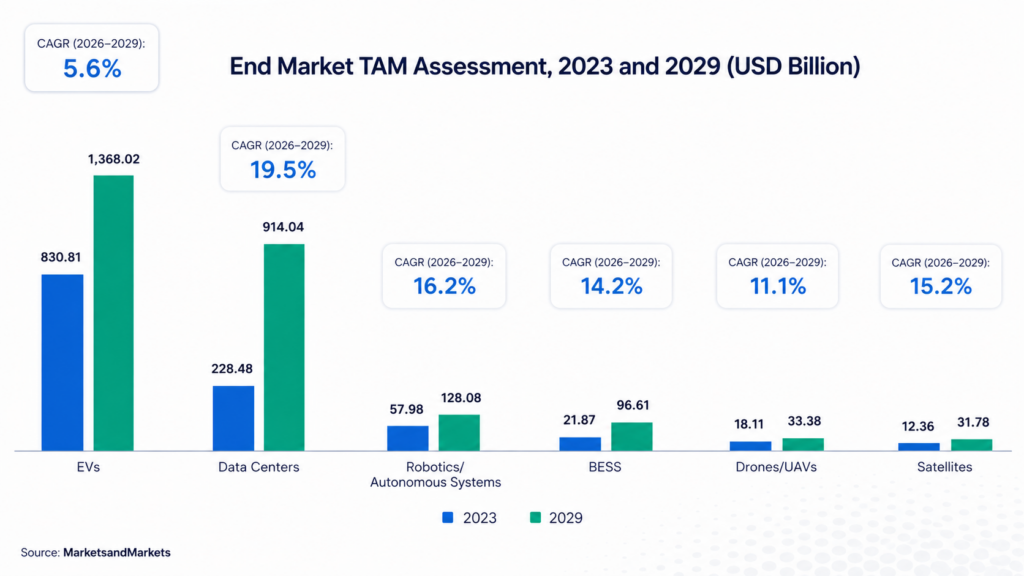
Battery energy storage system deployments have entered an exponential growth phase. Grid operators and utilities are deploying storage at scale to manage renewable intermittency, smooth peak demand, and harden grid resilience. In most major markets, the economics have crossed the viability threshold — storage is no longer a subsidy-dependent experiment but a core grid asset. The global market for energy storage tied to the grid and renewables is projected to reach roughly $96 billion by 2029, growing at around 14% a year.
EV adoption is crossing the chasm
Electric vehicle sales have moved well beyond early adopters. Commercial fleets, delivery vehicles, and public transit systems are electrifying at scale, and this is the part that changes the math: it isn’t about consumer preference anymore, it’s industrial transformation. Mobility remains the largest battery end market by a wide margin — on the order of $1.4 trillion by 2029 — and at fleet scale, every percentage point of battery performance and longevity translates directly into operating cost.
Data centers: the unexpected battery consumer
The rise of AI workloads has made data centers among the most demanding energy consumers on the planet. Battery systems are now critical for power resilience, load management, and backup — creating a vertical for battery demand that barely existed five years ago. It is also the fastest-growing: the data center and AI infrastructure battery market is projected to expand at roughly 19% annually, approaching $914 billion by 2029. As AI pushes the grid past what it was built to handle, the battery stops being a passive backup and becomes the layer everything else depends on.

Robotics: the next frontier
Humanoid robots, autonomous mobile systems, and industrial automation are creating an entirely new category of battery-dependent machines — projected to be a $128 billion market by 2029, growing around 16% annually. Each one demands battery management adapted to dynamic, unpredictable duty cycles, where load can swing from idle to peak in seconds. Static models simply weren’t built for this.
And the frontier keeps extending. Drones and UAVs are projected to reach roughly $33 billion by 2029 (around 11% annual growth), with satellites and orbital infrastructure adding another $32 billion at roughly 15%, some of the most safety- and performance-sensitive battery environments that exist, where there is no margin for a wrong prediction.
Put these markets side by side — mobility at roughly $1.4 trillion, data centers near $914 billion, robotics at $128 billion, energy storage at $96 billion, drones and satellites in the tens of billions each — and a pattern becomes impossible to miss: electrification is no longer a single market. It’s a dozen of them, accelerating at once, each leaning on the same fundamental component, and each with different physics, chemistries, and duty cycles to manage.
Source Note: Unless otherwise stated, all market data, forecasts, and insights presented from this point forward are derived from the MarketsandMarkets™ Battery Management System Market – Global Forecast (2026).
The missing layer
Here is the gap. As also mentioned by IEA — The battery industry has entered a new phase, hardware is advancing rapidly — but the software managing these systems has barely changed. Most battery management still relies on static models, conservative safety margins, and limited real-time intelligence. We are deploying twenty-first-century batteries and running them on logic that would be familiar from twenty years ago. Put plainly: the era of the dumb battery — passive, monitored, managed by fixed rules — is ending. And it leaves behind a question the old category was never built to answer: not what is this battery doing right now? but what will it do next, and what should we do about it?
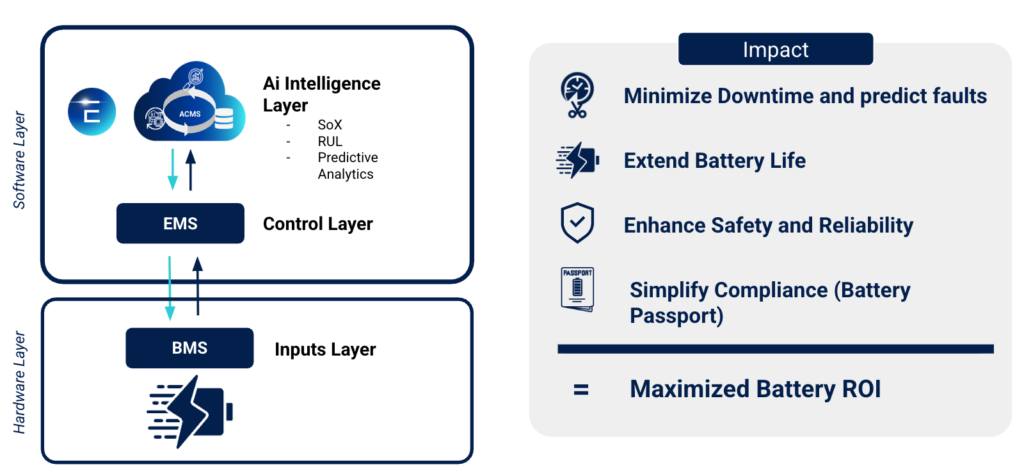
This is the gap that battery intelligence fills: a physics-based AI layer that sits between the hardware and the application, turning batteries from passive components into intelligent, adaptive systems. It doesn’t just do the old job better — it changes the thing we measure. The old scoreboard was the accuracy of monitoring: how faithfully you could read a battery’s present. The new one is the quality of prediction: how reliably you can see a battery’s future and act before it arrives. That shift — from monitoring to reasoning — is the whole category. And whoever defines the scoreboard defines the category.
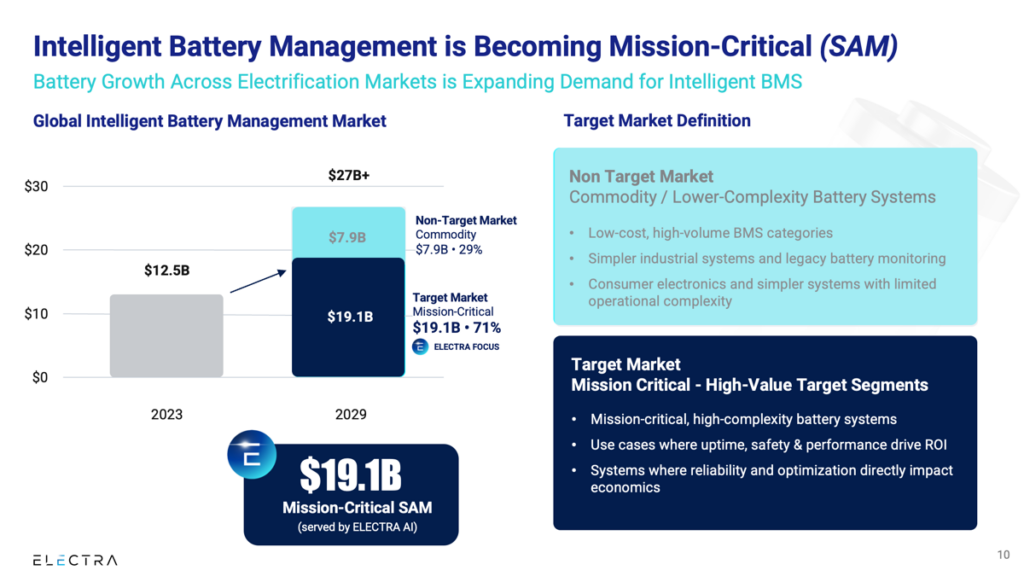
And this layer is becoming mission-critical, not optional. The global market for intelligent battery management is projected to more than double — from around $12.5 billion in 2023 to over $27 billion by 2029. But not all of that market is the same. A portion — an estimated $7.9 billion, roughly 29% — is commodity territory: low-cost, high-volume systems, simpler industrial and legacy monitoring, consumer electronics with limited operational complexity. Important, but not where intelligence earns its keep.
The high-value core is the other 71% — an estimated $19.1 billion of mission-critical, high-complexity battery systems. These are the use cases where uptime, safety, and performance directly drive ROI, where reliability and optimization don’t just improve the economics, they are the economics. A grid asset that has to run for twenty years. A data center that cannot go dark. A fleet whose margins live or die on battery longevity. A satellite with no service call. In these segments, reliability isn’t a feature; it’s the business model — and it’s exactly where ELECTRA AI focuses.
Source Note: Unless otherwise stated, all market data, forecasts, and insights presented from this point forward are derived from the MarketsandMarkets™ Battery Management System Market – Global Forecast (2026).
The AI Brain for Batteries™ platform
A category needs more than a name — it needs something that embodies it. That is what we built. Electra’s AI Brain for Batteries™ platform is a physics-based AI layer that sits between the cell and the application: hardware-agnostic across battery platforms, adaptive across chemistries and use cases, and designed to work wherever there is a battery rather than for one narrow product line.
What makes it the standard for the category is how it reasons. Rather than fitting curves to historical data, it combines physics-based modeling with AI — so it understands battery behavior at the cell level, not just the patterns in a dataset. It predicts instead of reacts: estimating state of health, state of charge, and remaining useful life, flagging faults early, and optimizing how each asset is used in real time. And because it continuously learns from real-world deployment data, it gets sharper the more batteries it runs. This is the shift from monitoring to reasoning, made operational.
The value follows directly from the intelligence. Operators using the platform can extend asset life beyond standard limits, recover meaningful additional return from assets already in the ground, and reduce downtime and operational risk through early fault detection — turning a battery from a depreciating component into an asset that can be planned around. The same brain, applied across grid storage, data centers, mobility, robotics, and beyond: one intelligence layer, every battery, every market.
Why this decade matters
The convergence of three forces — maturing AI capability, falling battery costs, and surging electrification demand — has created the conditions for a new category to emerge. This doesn’t happen often. When it does, the companies that build the foundational layer don’t just participate in the market; they define how it works.
The intelligence layer for battery infrastructure is that foundational layer. The hardware will keep improving regardless. What determines how far this transition goes — how long assets last, how safely they run, how much value they return — is the software that understands them.
ELECTRA AI was founded in 2015 to build exactly this: the AI Brain for Batteries™ platform. We didn’t set out to make a better battery management system. We set out to create the category the market didn’t yet have a name for — battery intelligence — and to define what it means to reason about a battery rather than merely watch it. Today, the market is catching up to the vision. The inflection point we anticipated is no longer on the horizon — it’s here. The only question left is who defines the layer on which everything else will depend on.
Market figures reflect 2029 estimates and are forward-looking by nature; actual results may differ.
About ELECTRA AI
ELECTRA AI (https://www.electrabrain.ai/) is the leading AI-driven cleantech and B2B software company, accelerating the world’s transition to electrification by unlocking the full potential of battery technology. ELECTRA AI builds the AI Brain for Batteries™ platform, a unified intelligence layer that enables battery systems to be monitored, optimized, and controlled across their full lifecycle. By combining Agentic AI, Physical AI, and Physics-informed Battery Modeling with Large Quantitative Models (LQMs), ELECTRA AI transforms batteries from passive hardware into intelligent, adaptive, and increasingly autonomous assets.
ELECTRA AI powers battery intelligence across every major battery-powered sector, including Energy Infrastructure (BESS for grid, renewables, and data centers), autonomous systems (robotics, humanoid, space assets), and e-mobility, helping make electrification safer, more resilient, and more economically productive. ELECTRA AI was co-founded in 2015 by Fabrizio Martini, inspired by work conducted as a Principal Investigator on NASA projects.
About Iron Horse Acquisition II Corp.
Iron Horse Acquisition II Corp. (Nasdaq: IRHO) (www.ironhorseacquisition.com) is a special purpose acquisition company co-founded by CEO and Chairman Jose Antonio Bengochea and CFO Bill Caragol. Iron Horse completed its initial public offering in December 2025, raising gross proceeds of approximately $230 million. Iron Horse was formed for the purpose of effecting a merger, capital stock exchange, asset acquisition, stock purchase, reorganization, or similar business combination with one or more businesses, with a particular focus on companies in the AI, media, and technology sectors.
Media Contacts
Giovanni Rossi
Head of Marketing and Communications @ ELECTRA AI
grossi@electrabrain.ai
Investor Relations for ELECTRA AI: ELECTRA@mzgroup.us
Forward-Looking Statements
Certain statements in this press release may be considered “forward-looking statements” within the meaning of the “safe harbor” provisions of the U.S. Private Securities Litigation Reform Act of 1995. Forward-looking statements generally relate to future events or Iron Horse’s or Electra’s future financial or operating performance. For example, statements regarding the anticipated timing of closing, expectations regarding the combined company’s business, and potential benefits of the transaction are forward-looking statements. In some cases, you can identify forward-looking statements by terminology such as “may,” “should,” “expect,” “intend,” “will,” “estimate,” “anticipate,” “believe,” “predict,” “potential,” or “continue,” or the negatives of these terms or variations of them or similar terminology. Such forward-looking statements are subject to risks, uncertainties, and other factors which could cause actual results to differ materially from those expressed or implied by such forward-looking statements. These forward-looking statements are based upon estimates and assumptions that, while considered reasonable by Iron Horse and Electra and their respective management teams, are inherently uncertain. Factors that may cause actual results to differ materially from current expectations include, but are not limited to: (i) the occurrence of any event, change, or other circumstances that could give rise to the termination of the BCA; (ii) the outcome of any legal proceedings that may be instituted against Iron Horse, Electra, the combined company, or others following the announcement of the transaction; (iii) the inability to complete the transaction due to the failure to obtain approval of the stockholders of Iron Horse or to satisfy other conditions to closing; (iv) changes to the proposed structure of the transaction that may be required or appropriate as a result of applicable laws or regulations or as a condition to obtaining regulatory approval of the transaction; (v) the ability to meet Nasdaq’s continued listing standards following the consummation of the transaction; (vi) the risk that the transaction disrupts current plans and operations of Electra as a result of the announcement and consummation of the transaction; (vii) the ability to recognize the anticipated benefits of the transaction, which may be affected by, among other things, competition, the ability of the combined company to grow and manage growth profitably, maintain relationships with customers and suppliers and retain its management and key employees; (viii) costs related to the transaction; (ix) changes in applicable laws or regulations; and (x) the possibility that Electra or the combined company may be adversely affected by other economic, business, and/or competitive factors. Nothing in this press release should be regarded as a representation by any person that the forward-looking statements set forth herein will be achieved or that any of the contemplated results of such forward-looking statements will be achieved. You should not place undue reliance on forward-looking statements, which speak only as of the date they are made. Neither Iron Horse nor Electra undertakes any duty to update these forward-looking statements, except as required by law.
No Offer or Solicitation
This press release does not constitute a solicitation of a proxy, consent, or authorization with respect to any securities or in respect of the proposed transaction, and shall not constitute an offer to sell or a solicitation of an offer to buy any securities, nor shall there be any sale of securities in any state or jurisdiction in which such offer, solicitation, or sale would be unlawful prior to registration or qualification under the securities laws of any such state or jurisdiction. No offering of securities will be made except by means of a prospectus meeting the requirements of Section 10 of the Securities Act of 1933, as amended, or an exemption therefrom.
Additional Information about the Business Combination and Where to Find It
In connection with the proposed business combination, Iron Horse and Electra have filed a registration statement on Form S-4 (the “Registration Statement”) with the SEC, which includes a proxy statement/prospectus, and certain other related documents, to be used at the meeting of stockholders to approve the proposed business combination. INVESTORS AND SECURITY HOLDERS OF IRON HORSE ARE URGED TO READ THE PROXY STATEMENT/PROSPECTUS, ANY AMENDMENTS THERETO, AND OTHER RELEVANT DOCUMENTS THAT WILL BE FILED WITH THE SEC CAREFULLY AND IN THEIR ENTIRETY WHEN THEY BECOME AVAILABLE BECAUSE THEY WILL CONTAIN IMPORTANT INFORMATION ABOUT ELECTRA, IRON HORSE, AND THE BUSINESS COMBINATION. The definitive proxy statement will be mailed to shareholders of Iron Horse as of a record date to be established for voting on the proposed business combination and other proposals. Investors and security holders will also be able to obtain copies of the Registration Statement and other documents containing important information about each of the companies once such documents are filed with the SEC, without charge, at the SEC’s website at www.sec.gov, or by directing a request to: Loeb & Loeb LLP.
Participants in the Solicitation
Iron Horse, Electra, and their respective directors and executive officers may be deemed to be participants in the solicitation of proxies from Iron Horse’s stockholders in connection with the proposed business combination. A list of the names of such directors and executive officers and information regarding their interests in the proposed business combination are contained in the Registration Statement.