


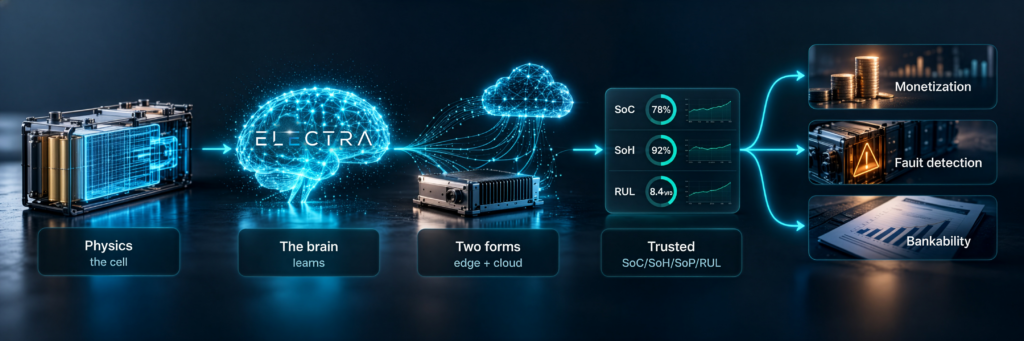
The layer nobody points a camera at
Physical AI’s attention goes to the coordinating mind — the planner, the policy, the foundation model deciding what the machine should do. Understandable: it’s visible, and it demos well. But a machine that manipulates, flies, drives or stores energy is judged on something quieter — whether each component reports its own state accurately, instant to instant, for years.
A coordinating model is only ever as good as the ground truth beneath it. Feed it a wrong state estimate and no amount of scale on top recovers the error — and the cost isn’t only technical. An asset whose true state is uncertain has to be de-rated, over-provisioned, and warranty-reserved against the worst case; that uncertainty is exactly what makes a battery expensive to operate and hard to monetize. Reliability — and the economics — begin at the component. And the hardest component to know is the battery.
The battery is the part that can’t explain itself
Almost every physical-AI machine — humanoid, drone, autonomous vehicle, data-centre rack, grid-scale store — runs on a battery. And the battery is the one component whose true state you can never read directly.
There is no sensor for State of Charge, State of Health or remaining life. Each has to be inferred from three noisy terminal signals — voltage, current, temperature — through a cell whose behaviour is nonlinear, hysteretic, temperature- and rate-dependent, and quietly changing as the SEI grows and active material is lost. Get that inference wrong and every axis moves at once: safety margin, usable energy, performance, lifetime — and the reserves you hold against all four.
A purely data-driven model breaks the moment the cell leaves the conditions it was trained on — a new duty cycle, a colder climate, a chemistry it hasn’t seen. The inference has to be anchored in the physics of the cell, and it has to live inside the battery, not just watch it from the cloud. In other words, the battery needs a brain.
The AI Brain for Batteries™
That is what Electra builds: an AI Brain for Batteries™ — one intelligence that understands a cell and stays right about it for a decade. It shows up in two forms, but it is one brain.
- On the pack — an AI-driven BMS. In its embedded form (EVE‑Ai™ Adaptive Controls, with Embedded SoXe at its core), the brain is essentially an AI-driven battery management system. Running on standard embedded microcontrollers — automotive-grade among them, but not only — it estimates SoC and SoH (within 1% error), and SoP (within 5% error) in microseconds, deterministically. It senses, infers and analyzes the cell’s signals at the point they occur.
- Across the fleet — in the cloud. The same brain reasons over the whole population (EVE‑Ai™ Battery Fleet Analytics): tracking how health and remaining life actually evolve, flagging fault and degradation risk before it trips, informing proactive maintenance, and carrying the Battery Passport.
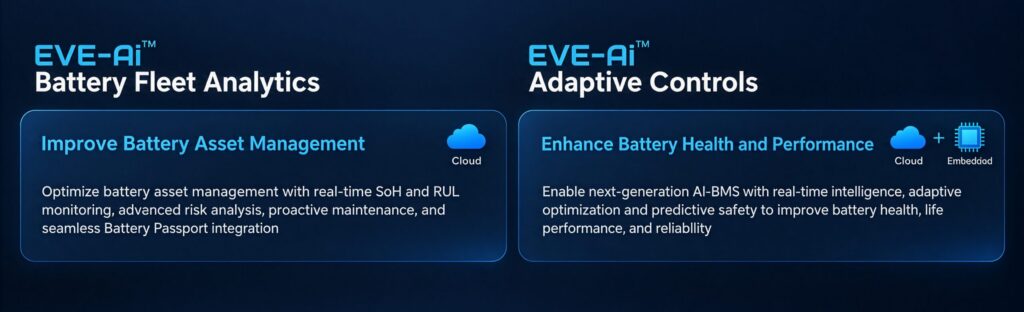
What makes it a brain rather than a gauge is that it learns. A patented, physics-informed model at its core keeps re-fitting itself to the real cell as that cell ages, and the fleet view continually sharpens the model that runs on the pack. Contrast the conventional approach: an Extended Kalman Filter over a fixed model, hand-tuned once, is accurate the day it’s calibrated and drifts thereafter — as resistance and capacity move, its assumptions no longer match the cell and the error compounds. Electra’s brain moves the other way: in validation, its accuracy holds across the battery’s life, where a fixed filter degrades. A model that tracks the cell instead of slowly forgetting it.And it is one brain, not one per product. Because it’s physics-informed rather than a lookup table, it’s hardware- and chemistry-agnostic — validated across silicon platforms and chemistries, and portable to anywhere there’s a battery: EVs, grid storage, data centers, humanoid robots, drones. One brain, many bodies.
What an accurate brain is worth
Everything the brain is worth starts from one thing it produces: an accurate, continuously-updated read of the battery’s state — charge, health, power, remaining life. Once you actually know the battery instead of guessing at it, three kinds of value open up.
- Monetization. A tighter state estimate lets an OEM stop designing against the worst case — less oversizing and buffer for the same usable range, and a lower cost per usable kilowatt-hour. And each state it reads opens a different lever: an accurate State of Charge lets you run closer to the real limits and pull more usable energy and range from the same pack, cycle after cycle; a trustworthy State of Health gives the battery a defensible residual value and a credible second life; an accurate State of Power lets an operator bid storage into grid and flexibility markets, or sell performance under guarantee. Knowing the state means you can use more of the battery, for longer, in more ways.
- Fault detection. The same models that estimate state also catch it going wrong early — abnormal aging, outlier cells, the first signatures of a developing fault — in time to act. That turns unplanned failures into scheduled maintenance, trims downtime, and heads off the warranty claims, recalls and safety incidents that quietly wreck a battery business’s economics. Reliability stops being a hope and becomes something you can manage.
- Bankability. Take monetization and reliability together and they add up to something larger: a battery you can put on a balance sheet with confidence. A battery becomes a financeable asset only when a third party will stand behind its numbers — an insurer to underwrite it, a lender to advance against it, a certifier or rating body to vouch for its residual value. None of them can act on a guess; they need a state they can trust, kept current for the life of the asset. That trustworthy, continuously-updated state is what the brain provides — the difference between a battery that is merely owned and one that can be insured, rated and financed
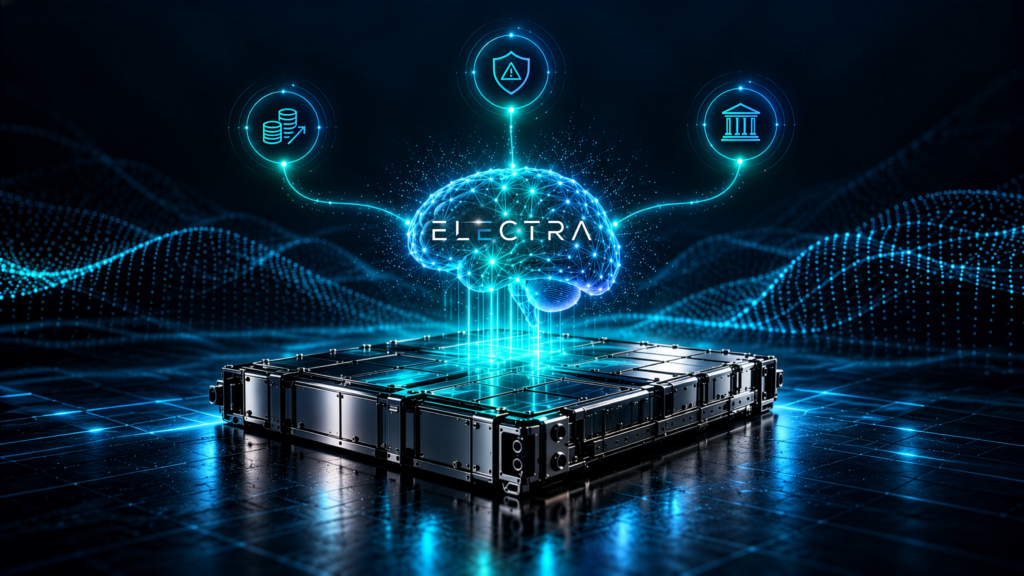
Where the brain fits
No one builds a humanoid, a drone fleet or a grid-scale store in order to think about cells. They build it to do a job — and they need the battery under it to be a known quantity. The brain sits between the machine’s coordinating intelligence and its physical pack: turning raw voltage, current and temperature into state the system above can trust, and translating the system’s demands into limits the pack can safely take. It’s built to fit rather than replace — running on the BMS and silicon the builder already uses, and learning across the builder’s whole fleet.
The takeaway
The coordinating models will keep the spotlight, and they’ve earned it. But in the physical world, reliability is decided underneath them — in the component that can’t speak for itself. For anything electrified, that’s the battery, and the answer is to give it a brain: one that reads its true state in real time, keeps learning as the cell ages, and stays honest long enough to build a business on. Get that right, and everything above it — the autonomy, the safety case, the economics — finally has something solid to stand on.
About ELECTRA AI
ELECTRA AI is the leading AI-driven cleantech and B2B software company, accelerating the world’s transition to electrification by unlocking the full potential of battery technology. ELECTRA AI builds the AI Brain for Batteries™ platform, a unified intelligence layer that enables battery systems to be monitored, optimized, and controlled across their full lifecycle. By combining Agentic AI, Physical AI, Physics-informed Battery Modeling with Large Quantitative Models (LQMs), ELECTRA AI transforms batteries from passive hardware into intelligent, adaptive, and increasingly autonomous assets.
ELECTRA AI powers battery intelligence across every major battery-powered sector, including Energy Infrastructure (BESS for grid, renewables, and data centers), autonomous systems (robotics, humanoid, space assets), and e-mobility, helping make electrification safer, more resilient, and more economically productive. ELECTRA AI was co-founded in 2015 by Fabrizio Martini, inspired by work conducted as a Principal Investigator on NASA projects.
ELECTRA AI has entered into a definitive business combination agreement with Iron Horse Acquisition II Corp. (Nasdaq: IRHO). The combined company is expected to list on Nasdaq in the second half of 2026 under the ticker AIBR. More information is available at https://www.electrabrain.ai/investors/.
About Iron Horse Acquisition II Corp.
Iron Horse Acquisition II Corp. (Nasdaq: IRHO) (www.ironhorseacquisition.com) is a special purpose acquisition company co-founded by CEO and Chairman Jose Antonio Bengochea and CFO Bill Caragol. Iron Horse completed its initial public offering in December 2025, raising gross proceeds of approximately $230 million. Iron Horse was formed for the purpose of effecting a merger, capital stock exchange, asset acquisition, stock purchase, reorganization, or similar business combination with one or more businesses, with a particular focus on companies in the AI, media, and technology sectors.
Forward-Looking Statements
Certain statements in this press release may be considered “forward-looking statements” within the meaning of the “safe harbor” provisions of the U.S. Private Securities Litigation Reform Act of 1995. Forward-looking statements generally relate to future events or Iron Horse’s or Electra’s future financial or operating performance. Forward-looking statements in this press release include, without limitation, statements regarding the anticipated capabilities, benefits, and outcomes of the commercial engagements, partnerships, and technical collaborations described herein, including statements regarding expected improvements in battery monitoring, performance, safety, fleet productivity, and financing confidence, as well as statements regarding the proposed business combination and the anticipated Nasdaq listing. These outcomes are subject to successful integration and deployment, technology performance, market conditions, and other factors beyond the parties’ control. In some cases, you can identify forward-looking statements by terminology such as “may,” “should,” “expect,” “intend,” “will,” “estimate,” “anticipate,” “believe,” “predict,” “potential,” or “continue,” or the negatives of these terms or variations of them or similar terminology. Such forward-looking statements are subject to risks, uncertainties, and other factors which could cause actual results to differ materially from those expressed or implied by such forward-looking statements. These forward-looking statements are based upon estimates and assumptions that, while considered reasonable by Iron Horse and Electra and their respective management teams, are inherently uncertain. Factors that may cause actual results to differ materially from current expectations include, but are not limited to: (i) the occurrence of any event, change, or other circumstances that could give rise to the termination of the BCA; (ii) the outcome of any legal proceedings that may be instituted against Iron Horse, Electra, the combined company, or others following the announcement of the transaction; (iii) the inability to complete the transaction due to the failure to obtain approval of the stockholders of Iron Horse or to satisfy other conditions to closing; (iv) changes to the proposed structure of the transaction that may be required or appropriate as a result of applicable laws or regulations or as a condition to obtaining regulatory approval of the transaction; (v) the ability to meet Nasdaq’s continued listing standards following the consummation of the transaction; (vi) the risk that the transaction disrupts current plans and operations of Electra as a result of the announcement and consummation of the transaction; (vii) the ability to recognize the anticipated benefits of the transaction, which may be affected by, among other things, competition, the ability of the combined company to grow and manage growth profitably, maintain relationships with customers and suppliers and retain its management and key employees; (viii) costs related to the transaction; (ix) changes in applicable laws or regulations; and (x) the possibility that Electra or the combined company may be adversely affected by other economic, business, and/or competitive factors. Nothing in this press release should be regarded as a representation by any person that the forward-looking statements set forth herein will be achieved or that any of the contemplated results of such forward-looking statements will be achieved. You should not place undue reliance on forward-looking statements, which speak only as of the date they are made. Neither Iron Horse nor Electra undertakes any duty to update these forward-looking statements, except as required by law.
This article contains forward-looking statements about ELECTRA AI’s technology and products and their potential benefits, including statements regarding future capabilities, performance and roadmap. Such statements reflect current expectations and assumptions, are subject to risks and uncertainties, and actual results may differ materially. Any performance figures are illustrative and based on specific test or deployment conditions that may not be representative of all use cases. You should not place undue reliance on these statements, which speak only as of the date of this article, and Electra undertakes no obligation to update them except as required by law.
No Offer or Solicitation
This press release does not constitute a solicitation of a proxy, consent, or authorization with respect to any securities or in respect of the proposed transaction, and shall not constitute an offer to sell or a solicitation of an offer to buy any securities, nor shall there be any sale of securities in any state or jurisdiction in which such offer, solicitation, or sale would be unlawful prior to registration or qualification under the securities laws of any such state or jurisdiction. No offering of securities will be made except by means of a prospectus meeting the requirements of Section 10 of the Securities Act of 1933, as amended, or an exemption therefrom.
Additional Information about the Business Combination and Where to Find It
In connection with the proposed business combination, Iron Horse and Electra have filed a registration statement on Form S-4 (the “Registration Statement”) with the SEC, which includes a proxy statement/prospectus, and certain other related documents, to be used at the meeting of stockholders to approve the proposed business combination. INVESTORS AND SECURITY HOLDERS OF IRON HORSE ARE URGED TO READ THE PROXY STATEMENT/PROSPECTUS, ANY AMENDMENTS THERETO, AND OTHER RELEVANT DOCUMENTS THAT WILL BE FILED WITH THE SEC CAREFULLY AND IN THEIR ENTIRETY WHEN THEY BECOME AVAILABLE BECAUSE THEY WILL CONTAIN IMPORTANT INFORMATION ABOUT ELECTRA, IRON HORSE, AND THE BUSINESS COMBINATION. The definitive proxy statement will be mailed to shareholders of Iron Horse as of a record date to be established for voting on the proposed business combination and other proposals. Investors and security holders will also be able to obtain copies of the Registration Statement and other documents containing important information about each of the companies once such documents are filed with the SEC, without charge, at the SEC’s website at www.sec.gov, or by directing a request to: Loeb & Loeb LLP.
Participants in the Solicitation
Iron Horse, Electra, and their respective directors and executive officers may be deemed to be participants in the solicitation of proxies from Iron Horse’s stockholders in connection with the proposed business combination. A list of the names of such directors and executive officers and information regarding their direct and indirect interests in the proposed business combination, by security holdings or otherwise are set forth in the proxy statement/prospectus included in the Registration Statement filed with SEC, and is available free of charge at www.sec.gov.
Media Contacts
ELECTRA AI
Giovanni Rossi – grossi@electrabrain.ai
IRON HORSE
Bill Caragol – bill@ironhorseacquisition.com